
This article contains affiliate links. We may earn a commission if you make a purchase through these links, at no additional cost to you.
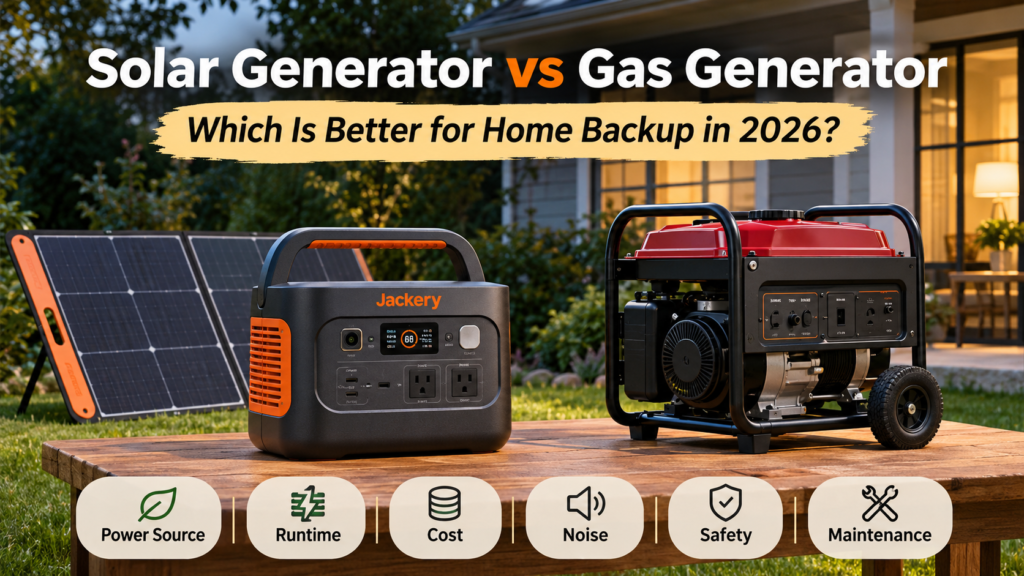
When comparing a solar generator vs gas generator, it’s easy to focus on the obvious differences. One runs on stored electricity, while the other burns fuel. But when the power actually goes out, what matters is whether your backup system can keep the appliances you depend on running, how long it will last, and how much effort it takes to operate.
Imagine losing electricity in the middle of a workday. Your laptop still has some battery life, but your internet router has shut down. The refrigerator is slowly warming up, and you’re wondering whether the outage will last an hour or the entire afternoon. In this situation, a portable solar generator could be a convenient solution because it can provide electricity almost immediately, without starting an engine or dealing with fuel.
Now imagine a different situation: a severe storm leaves your neighborhood without electricity for two days. You need to keep food refrigerated, operate several electric fans, charge devices, and possibly run a water pump. Suddenly, battery capacity and recharging options become much more important. A gas generator might be more practical if you have a safe outdoor operating area and a reliable supply of fuel.
Neither solution is automatically better. Solar generators are generally quieter, require less routine maintenance, and can be used indoors according to the manufacturer’s instructions. Gas generators can often handle larger electrical loads and continue operating through refueling, but they introduce noise, exhaust, and ongoing maintenance requirements.
This guide compares both options from a homeowner’s perspective, looking at power output, runtime, operating costs, convenience, and safety to help you choose a backup system that fits your household’s actual needs.
Quick Answer: Solar Generator vs Gas Generator
A solar generator is generally better for quiet, convenient backup power for essential electronics and selected household appliances. A gas generator is often better for higher electrical loads and prolonged outages when sufficient fuel and a safe outdoor operating area are available.
The better choice depends on how much electricity your household needs, how frequently outages occur, and whether you can reliably recharge a battery or replenish fuel. For some households, a combination of both technologies may provide greater flexibility than relying on either one alone.
Solar Generator vs Gas Generator: Side-by-Side Comparison
Before looking at the technical differences, it helps to understand how these systems compare in everyday use. Both can supply electricity when the grid is unavailable, but the experience of owning and operating them is quite different.
| Feature | Solar Generator | Gas Generator |
|---|---|---|
| Power source | Rechargeable battery | Gasoline or other compatible fuel |
| How it works | Stores electricity from wall charging or compatible solar panels | Uses an engine to generate electricity |
| Noise | Generally quiet, with occasional cooling fan noise | Engine noise during operation |
| Indoor use | Generally suitable when used according to manufacturer instructions | Never safe indoors |
| Runtime | Depends on battery capacity and recharging | Depends on fuel supply and consumption |
| Recharging or refueling | Wall outlet, solar panels, or supported charging methods | Requires compatible fuel |
| Maintenance | Battery care and basic inspections | Oil changes, engine servicing, and fuel maintenance |
| Operating costs | Charging electricity and optional solar equipment | Fuel and ongoing maintenance |
| Portability | Varies by battery size and weight | Varies by engine size and fuel capacity |
| Best suited for | Electronics, selected appliances, and quiet backup | Larger loads and extended outages |
| Main limitation | Limited stored energy | Fuel dependence, exhaust, noise, and maintenance |
The most important takeaway is that power output and runtime are separate considerations. A solar generator might have enough output to start a refrigerator but not enough stored energy to keep it operating for an entire day. A gas generator may be capable of running several appliances for hours, but only while fuel is available and the equipment can be operated safely.
These differences become clearer when you look at how each system works.
What Is a Solar Generator and How Does It Work?
A solar generator is essentially a rechargeable battery system with a built-in inverter that allows you to power ordinary electrical devices. Most models can be charged from a household outlet, and many also support compatible solar panels, making them useful when grid electricity is unavailable.
The term solar generator can be slightly misleading because the power station itself doesn’t generate electricity from sunlight. The solar panels convert sunlight into electrical energy, while the battery stores that energy for later use. You can still use the power station without solar panels as long as its battery has been charged through another supported method.
One reason these systems have become appealing for home backup is their simplicity. During an outage, you can connect compatible devices directly to the power station without starting an engine, handling gasoline, or running extension cords from a generator outside. For smaller household needs, this can make backup electricity much more accessible.
Consider a household that mainly wants to keep its internet connection, laptops, phones, and a few lights operating during occasional blackouts. A portable power station with around 1,000Wh of battery capacity may provide several hours of useful backup electricity, depending on the connected load. It can also be moved between rooms or stored away when not needed.
Manufacturers such as Jackery, EcoFlow, BLUETTI, and Anker offer portable power stations in different capacity ranges. For example, the Jackery Explorer series includes compact models for essential electronics as well as larger options for households that need additional stored energy. The right capacity depends on the appliances you plan to operate rather than simply choosing the largest battery available.
Where Solar Generators Make the Most Sense
Solar generators are particularly useful when convenience, quiet operation, and portability matter more than powering an entire household. They work well for home offices, apartments, small households, and situations where you need backup electricity for a limited number of devices.
Their lack of combustion exhaust during operation is another important advantage. Unlike fuel-powered generators, battery power stations can generally be used indoors when operated according to manufacturer instructions, with adequate ventilation and appropriate charging conditions.
They also require relatively little routine maintenance. There is no engine oil to change, spark plug to replace, or fuel system to maintain. Owners still need to follow battery storage recommendations, keep the unit clean and dry, and periodically check its charge level, especially if it is reserved for emergencies.
The main drawback is that a battery contains a limited amount of energy. Once that energy is used, the power station must be recharged. Solar panels can help, but their output depends on sunlight, weather, panel positioning, and charging compatibility. During several cloudy days, a solar generator may struggle to replenish enough electricity to meet ongoing household demand.
This is why a portable power station that performs well during a four-hour blackout may be less practical during a two-day outage unless you have sufficient battery capacity and a dependable way to recharge it.
What Is a Gas Generator and How Does It Work?
A gas generator produces electricity using an internal combustion engine. Most portable models run on gasoline, although some support propane or multiple fuel types. As the engine operates, it drives a generator that supplies electricity to connected appliances.
Unlike a solar generator, which draws from electricity already stored in a battery, a gas generator continues producing power as long as it has fuel and is operating within its limits. This makes it useful for households that need sustained electricity for larger loads or longer periods.
For example, a homeowner might use a gas generator during an extended outage to support refrigeration, lighting, fans, and a water pump. Depending on the generator’s rated output and the appliances’ electrical requirements, it may be able to operate several of these devices simultaneously.
Gas generators are also available in a wide range of sizes. Smaller inverter generators are designed for relatively modest loads and can be more fuel-efficient and quieter than some conventional models. Larger portable generators may provide enough output for more demanding household equipment, although they generally consume more fuel and require more space.
Why Some Homeowners Still Prefer Gas Generators
One of the strongest reasons to choose a gas generator is the ability to replenish its energy supply relatively quickly. Instead of waiting for a battery to recharge, you can safely shut down the generator, allow it to cool, and refuel it according to the manufacturer’s instructions.
This can be particularly valuable during prolonged outages when solar charging conditions are poor or electricity demand is too high for a practical portable battery system.
Gas generators may also have a lower initial purchase price than large battery systems with comparable continuous power output. However, the purchase price doesn’t tell the whole story. Fuel expenses, maintenance, replacement parts, and operating frequency all contribute to the long-term cost of ownership.
The trade-off is that gas generators require more attention. Engines need periodic servicing, fuel must be stored properly, and the equipment should be tested and maintained so it is ready when needed. They also produce noise that may be disruptive in densely populated neighborhoods.
Safety is another major consideration. Fuel-powered generators produce carbon monoxide, a poisonous gas that can accumulate rapidly in enclosed or partially enclosed spaces. The U.S. Consumer Product Safety Commission advises keeping portable generators outdoors, at least 20 feet away from homes, with exhaust directed away from the building.
A gas generator must never be operated inside a house, garage, or other enclosed space, even with doors or windows open. For homeowners without a suitable outdoor location, this requirement alone may make a battery-powered system the more practical option.
Solar Generator vs Gas Generator: Which Provides More Power?
Power output is one of the first specifications homeowners compare, but it can also be one of the most confusing. A generator’s advertised wattage tells you how much electrical power it can supply at a particular moment. It doesn’t necessarily tell you how long that power will remain available.
Gas generators often provide higher continuous output than compact solar generators, making them useful for appliances with substantial electrical demands. However, larger portable battery systems can also deliver significant output, so the comparison should always be made between specific models.
For example, a 2,000W solar generator may be capable of running an appliance that consumes 1,500W, provided the appliance’s startup requirements are within the generator’s limits. But if the power station has only 1,000Wh of battery capacity, that appliance could drain the battery in well under an hour.
A gas generator with a similar continuous output rating could operate the same appliance for longer if sufficient fuel is available. Its runtime would depend on engine efficiency, fuel tank capacity, and how heavily the generator is loaded.
Why Battery Capacity Matters Just as Much as Wattage
Solar generators usually display two important specifications: watts (W) and watt-hours (Wh). Although they sound similar, they describe different things.
Watts measure the rate at which electricity is being used or supplied. Watt-hours measure the amount of energy stored in a battery. Think of watts as how quickly you’re using electricity and watt-hours as how much electricity you have available.
Suppose you have a portable power station with 1,000Wh of battery capacity. If your connected devices consume a combined 100W, the theoretical runtime would be 10 hours. In practice, conversion losses and the power station’s own consumption will reduce that figure.
If you connect a 1,000W appliance instead, the same battery will drain much faster. Even though the inverter may be capable of supporting the appliance, the stored energy won’t last long.
This distinction is particularly important for refrigerators, pumps, and appliances with motors. These devices may briefly draw substantially more electricity when starting than during normal operation. Before choosing either type of generator, check the appliance’s continuous power consumption and startup requirements.
A generator that cannot handle the initial surge may shut down or fail to start the appliance, even if its rated continuous output appears sufficient.
Solar Generator vs Gas Generator: Which Lasts Longer During a Blackout?
Runtime becomes especially important when a power outage lasts longer than expected. A backup system that comfortably supports a few hours without electricity may struggle when the outage extends overnight or into the following day.
With a solar generator, runtime depends primarily on battery capacity and how much electricity your devices consume. A larger battery generally provides longer operation, but the difference can be substantial depending on the appliances connected.
Consider a household using approximately 200W continuously for a laptop, internet equipment, lighting, and other small devices. A 1,000Wh power station, assuming 85% usable energy, would provide around 4.25 hours of backup electricity. Doubling the battery capacity to 2,000Wh would increase the estimated runtime to approximately 8.5 hours under the same conditions.
These are simplified estimates, and actual performance varies with inverter efficiency, battery condition, temperature, and electrical load. Nevertheless, they demonstrate why understanding household energy consumption is more useful than looking at battery capacity alone.
Gas generators work differently because they continuously produce electricity while running. Their operating time depends on the fuel tank, fuel consumption, and connected load. Manufacturers often publish runtime estimates at specific load levels, such as 25% or 50% of rated output, which can help homeowners compare models.
When the fuel tank runs low, the generator can be shut down, allowed to cool, and safely refueled. This gives gas generators a practical advantage during extended outages, assuming additional fuel is available.
What Happens During a Multi-Day Power Outage?
A multi-day blackout is where the limitations of both technologies become more noticeable.
A solar generator can be particularly useful when paired with compatible solar panels, allowing the battery to recover some of its energy during daylight hours. However, the amount of electricity collected may be much lower than expected during cloudy or rainy weather. If the household consumes more energy each day than the panels can replace, the battery will eventually run down.
Gas generators are less dependent on weather conditions for electricity production, but they rely on access to fuel. During severe storms or widespread emergencies, fuel stations may be closed, transportation may be disrupted, and stored fuel may not be sufficient for several days of operation. Generators also need appropriate maintenance and safe operating conditions.
For this reason, neither option should be treated as a guarantee of unlimited backup electricity. The more reliable approach is to calculate how much energy your essential devices consume each day, then determine whether your chosen system can realistically supply and replenish that amount.
For a household that only needs refrigeration, internet access, lighting, and device charging, a sufficiently sized solar generator may provide useful backup without the inconvenience of a fuel-powered engine. For a larger home with water pumps, multiple refrigerators, and other demanding appliances, a properly sized gas generator may offer more practical sustained output.
The best choice ultimately depends on how much electricity you need, how long you need it, and which energy source you can access reliably when the grid is unavailable.
Solar Generator vs Gas Generator: Which Costs Less in the Long Run?
The price of a backup generator is often one of the biggest factors in a homeowner’s decision. At first glance, gas generators can seem more affordable because many models offer substantial electrical output for a lower purchase price than comparable battery-powered systems. However, the initial cost is only part of the picture.
A solar generator generally costs more upfront because you’re paying for a rechargeable battery, inverter, charging electronics, and other components in one unit. If you also want to recharge it using sunlight, compatible solar panels add to the initial investment. On the other hand, a battery-powered system doesn’t require gasoline, engine oil, or regular engine servicing.
Gas generators have different expenses. Aside from the purchase price, you need to account for fuel, oil changes, replacement filters, and occasional repairs. These costs may be relatively small if you only use the generator a few times a year, but they can become significant when outages are frequent or prolonged.
Comparing Purchase and Operating Costs
The following table summarizes the main expenses associated with each type of generator.
| Cost Factor | Solar Generator | Gas Generator |
|---|---|---|
| Initial purchase | Often higher for substantial battery capacity | Often lower for comparable continuous output |
| Fuel or charging | Electricity for charging; sunlight can reduce grid charging needs | Ongoing fuel purchases |
| Solar panels | Additional expense unless included | Not required |
| Routine maintenance | Generally minimal | Oil, filters, spark plugs, and engine servicing |
| Replacement components | Battery or electronics may eventually need replacement | Engine parts and other mechanical components |
| Long-term expenses | Depend on charging costs, battery life, and usage | Depend heavily on fuel prices and operating hours |
For households that experience only occasional short blackouts, a smaller solar generator may offer good value because it requires little attention between uses. You can keep it charged, store it properly, and bring it out when electricity is unavailable.
However, a larger solar generator with enough battery capacity to support multiple appliances can represent a substantial investment. If you rarely experience outages, the additional capacity may not justify the expense.
Gas generators can be more economical when high electrical output is the priority and the equipment is used infrequently. But if you’re operating a generator for several hours every week, fuel and maintenance costs deserve closer attention.
The most useful comparison is the total cost of ownership over several years rather than the price displayed at checkout.
Solar Generator vs Gas Generator: Noise, Convenience, and Maintenance
Cost and electrical output matter, but so does the experience of using a generator at home. This is particularly important in residential neighborhoods, where noise, storage space, and ease of operation can influence whether a backup system is practical.
A solar generator is usually straightforward to operate. Once the battery is charged, you connect compatible devices and turn on the required outputs. Some models also provide mobile apps that let you monitor battery capacity, power consumption, and charging status.
Gas generators require more preparation. Before starting one, you need to check the fuel level, make sure the equipment is in suitable operating condition, and position it safely outdoors. Depending on the model, starting may involve a manual pull cord or an electric starter.
Neither process is necessarily difficult, but the difference becomes noticeable when electricity goes out unexpectedly, especially at night or during poor weather.
Which Generator Is Quieter?
Solar generators have a clear advantage when quiet operation is important. Because they don’t use combustion engines, their main source of operating noise is usually the cooling fan. Under lighter loads, some models are barely noticeable, although fan noise can increase during heavy use or fast charging.
Gas generators produce engine noise whenever they’re operating. Inverter generators are often quieter than conventional open-frame models, but they still produce more sound than most battery-powered systems.
For someone working from home, caring for young children, or living close to neighbors, noise can be an important consideration. A generator that sounds acceptable during the afternoon may become disruptive when operated throughout the night.
Which Requires Less Maintenance?
Solar generators generally require less routine maintenance because they have fewer moving parts. Owners still need to follow the manufacturer’s battery storage recommendations, protect the unit from moisture and extreme temperatures, and periodically inspect charging cables and connections.
Gas generators require regular engine maintenance, even if they aren’t used frequently. Depending on the model, this may include oil changes, air-filter cleaning, spark-plug replacement, and fuel-system care.
Long periods of storage can also create problems if gasoline deteriorates or the generator isn’t maintained properly. A gas generator that hasn’t been started or serviced for a long time may fail when you need it most.
For homeowners who want emergency equipment that requires relatively little attention, a solar generator may be easier to manage. However, battery-powered systems also need periodic charging and proper storage to remain ready for emergencies.
Which Generator Is Safer for Home Use?
Safety is one of the most important differences between solar and gas generators, particularly for homeowners who live in apartments, townhouses, or properties with limited outdoor space.
Gas generators produce carbon monoxide as part of the combustion process. This gas is colorless and odorless, and exposure can cause serious illness or death. For this reason, fuel-powered generators must never be operated inside a house, garage, basement, or other enclosed or partially enclosed space.
The U.S. Consumer Product Safety Commission recommends operating portable generators outdoors, at least 20 feet away from homes, with the exhaust directed away from doors, windows, and other openings. Carbon monoxide alarms are also an important part of household emergency preparedness.
Solar generators don’t produce combustion exhaust during normal battery operation, making them more suitable for indoor use when the manufacturer’s instructions are followed. However, this doesn’t mean they are completely risk-free.
Portable power stations contain high-capacity batteries and electrical components that can become hazardous if damaged, improperly charged, or exposed to unsuitable conditions. Owners should use compatible charging equipment, avoid obstructing ventilation openings, and follow the manufacturer’s temperature and storage recommendations.
Electrical connections also require attention. Neither a solar generator nor a gas generator should be connected to household wiring through an improvised cable or ordinary wall outlet. Supplying power to home circuits requires appropriate transfer equipment and professional installation to prevent dangerous backfeeding.
For most households, the safest and simplest approach is to connect compatible appliances directly to the generator’s designated outputs unless a properly designed home backup system has been installed.
Which Generator Is Better for Different Household Situations?
The most useful way to compare generators is to think about the situations in which you’ll actually need them. A household preparing for occasional afternoon blackouts has very different requirements from one that regularly experiences multi-day outages.
For Apartments and Condominiums
A solar generator is generally the more practical choice for apartments and condominiums because it doesn’t produce combustion exhaust and can usually be operated indoors according to the manufacturer’s instructions.
A compact portable power station may be enough to support laptops, phones, internet equipment, lighting, and small appliances during temporary outages. It can also be stored without keeping gasoline on the property.
Gas generators are usually unsuitable for apartment balconies, corridors, or other confined areas because exhaust can enter nearby living spaces. Building rules may also prohibit their use.
For apartment residents, the priority should be identifying essential devices and choosing a battery system with sufficient capacity for the expected outage duration.
For Home Offices and Remote Workers
If your income depends on having a working computer and reliable internet access, even a short blackout can be disruptive. In this situation, convenience and immediate access to electricity may matter more than maximum generator output.
A solar generator can keep compatible laptops, monitors, routers, and modems operating for a limited period. However, it won’t necessarily prevent a desktop computer from shutting down at the exact moment electricity fails.
For equipment that requires uninterrupted power, a dedicated UPS may still be necessary. Some portable power stations offer automatic transfer features, but their transfer times vary and should not be assumed to provide the same protection as a properly selected UPS.
Homeowners can also reduce their backup power requirements by improving the efficiency of their workspace. Using a laptop instead of a desktop computer, reducing unnecessary monitor usage, and disconnecting nonessential equipment can help extend battery runtime.
For Families With Refrigerators and Essential Appliances
Refrigeration is often one of the biggest concerns during an extended blackout, particularly for families storing perishable food.
Both solar and gas generators may be capable of powering a refrigerator, provided they can handle its running and startup electrical requirements. The difference is how long they can keep it operating.
A solar generator with sufficient battery capacity may support refrigeration during a shorter outage. Because refrigerators cycle on and off, actual energy consumption can be lower than their compressor’s running wattage might suggest. However, battery runtime still needs to be calculated using realistic energy measurements.
Gas generators may be more suitable when refrigeration must continue for extended periods and reliable fuel supplies are available. They can also support additional appliances, depending on the generator’s capacity.
Whichever system you choose, reducing unnecessary electricity consumption can make backup power last longer. Keeping refrigerator doors closed, avoiding unnecessary appliance use, and prioritizing essential loads can make a meaningful difference.
For Homes That Experience Frequent or Extended Blackouts
Frequent outages change the economics of backup power because the system may be used regularly rather than occasionally.
A solar generator paired with properly sized solar panels can be useful when sunlight is reasonably reliable. It allows homeowners to replenish some of their stored electricity without depending entirely on the grid.
However, solar charging is not unlimited. A household consuming several kilowatt-hours of electricity every day may need substantial battery capacity and solar panel area to maintain that level of usage during an outage.
Gas generators can provide sustained electricity when fuel is available, making them useful for higher loads or longer interruptions. The trade-off is ongoing fuel consumption, noise, maintenance, and the need for safe outdoor operation.
Some homeowners may benefit from combining the two approaches. A battery-powered station can handle quiet, low-power needs overnight, while a gas generator can provide additional electricity when larger loads must be operated or the battery needs recharging.
This arrangement requires compatible equipment and safe operating procedures, but it illustrates why backup power doesn’t always have to be an either-or decision.
Can You Use a Solar Generator and Gas Generator Together?
Yes, some homeowners use both systems as part of a broader emergency power plan. The two technologies can complement each other because they address different limitations.
A solar generator can provide quiet electricity for essential devices without running an engine continuously. A gas generator can supply additional power during extended outages, particularly when sunlight is insufficient to recharge the battery.
Some portable power stations also support charging from compatible generator-produced AC electricity. However, compatibility should be confirmed with the power station manufacturer, as generator output quality, grounding arrangements, and charging requirements can affect safe operation.
If you’re considering this setup, the gas generator must remain outdoors in a safe location, and all connections should follow the manufacturers’ instructions. Never connect generator outputs together or attempt to combine them using improvised wiring.
For households that experience frequent outages, a carefully planned combination may offer more flexibility than relying entirely on one power source.
How to Choose Between a Solar Generator and Gas Generator
Before buying either type of generator, start by identifying what you actually need to power. It’s tempting to choose the largest system you can afford, but that may lead to unnecessary spending without improving your emergency preparedness.
First, make a list of essential devices and estimate their electrical consumption. Include the equipment you genuinely need during an outage, such as refrigeration, internet access, lighting, fans, and communication devices. Check whether any appliances require additional startup power.
Next, consider how long outages typically last in your area. A battery system that provides four to eight hours of backup electricity may be sufficient for occasional interruptions. If outages regularly continue for several days, you’ll need to think more carefully about recharging or refueling.
Your living situation also matters. Homeowners with adequate outdoor space may be able to operate a gas generator safely, while apartment residents may find a battery-powered system more practical.
Finally, consider the total cost of ownership. A solar generator may require a higher initial investment, particularly if solar panels are included, but ongoing operating costs can be relatively low. Gas generators may offer more output for the initial purchase price, although fuel and maintenance expenses continue throughout ownership.
The best system is the one that reliably supports your essential electrical needs without creating unnecessary costs or safety risks.
Frequently Asked Questions
Is a solar generator better than a gas generator?
A solar generator is generally better for quiet operation, indoor convenience, and lower routine maintenance. A gas generator may be better for higher electrical loads and extended outages when fuel is available. The right choice depends on your household’s electricity requirements and operating conditions.
Can a solar generator replace a gas generator?
For smaller backup loads, a properly sized solar generator may replace a gas generator. However, homes that require sustained power for multiple high-wattage appliances may need a larger battery system, additional charging capacity, or another backup solution.
How long can a solar generator run a refrigerator?
Runtime depends on the refrigerator’s energy consumption, the solar generator’s battery capacity, and conversion efficiency. A refrigerator’s compressor cycles on and off, so measuring its actual energy use provides a more reliable estimate than relying only on its rated running wattage.
Is it cheaper to run a solar generator or a gas generator?
Solar generators generally have lower routine operating costs because they don’t require fuel or engine servicing. However, their initial purchase price can be higher, especially for larger battery systems. Gas generators may cost less upfront but require ongoing fuel and maintenance expenses.
Can I use a solar generator indoors?
Most portable battery-based solar generators can be used indoors when operated according to the manufacturer’s instructions. They don’t produce combustion exhaust during normal operation, but they still require proper ventilation, compatible charging equipment, and safe storage conditions.
Do solar generators work during cloudy weather?
Yes, a solar generator can supply electricity from its stored battery energy regardless of the weather. However, cloudy conditions can reduce the amount of electricity produced by connected solar panels, potentially increasing the time required to recharge the battery.
Can a gas generator charge a solar generator?
Some portable power stations can be charged using electricity from a compatible gas generator. However, the power station must support the generator’s electrical output, and all charging connections must follow the manufacturers’ requirements. The gas generator must remain outdoors during operation.
Final Thoughts
The solar generator vs gas generator decision ultimately comes down to how much electricity you need, how long you need it, and how you plan to replenish your backup energy supply.
Solar generators are particularly appealing for homeowners who value quiet operation, convenience, and minimal routine maintenance. They’re well suited to keeping essential electronics, internet equipment, lighting, and selected appliances operating during shorter outages. With compatible solar panels, they can also provide a way to replenish stored energy when sunlight is available.
Gas generators remain useful for households that need higher electrical output or sustained electricity during prolonged blackouts. Their ability to continue operating through refueling can be a major advantage, although fuel availability, engine maintenance, noise, and carbon monoxide safety requirements must all be considered.
For many households, the best approach is to begin with a realistic assessment of essential electricity needs rather than focusing on which technology sounds more advanced. A properly sized backup system that you can operate safely and maintain reliably will be more useful than an oversized generator that doesn’t fit your living situation.
Whether you choose a portable solar generator, a conventional gas generator, or a combination of both, planning ahead can make power outages less disruptive and help keep your household’s most important devices operating when electricity is unavailable.
Did this solve your problem?
Your answer helps Supportia prioritize updates. No account or email is required.
Related guides
Best Solar Generators for Home Use in 2026: Top Options Compared
The best solar generators for home use in 2026 include the Jackery Explorer 1000 v2 for essential electronics, EcoFlow DELTA 2 Max for larger…
Historical guide — verify current detailsBest Backup Power Solutions for Working From Home in 2026
A UPS is best for preventing sudden PC shutdowns, a power bank suits laptops, and a portable power station supports multiple devices during longer…
Historical guide — verify current details
iPhone vs Android in 2026: Which One Is Finally Better?
Choosing between iPhone and Android in 2026 comes down to your priorities. Both platforms have reached a point where AI, hardware, and software updates…
Historical guide — verify current details