
This article contains affiliate links. We may earn a commission if you make a purchase through these links, at no additional cost to you.
The best solar generators for home use can help keep essential devices running during power outages without the noise, exhaust fumes, or fuel requirements of traditional gasoline generators. Whether you need backup electricity for a refrigerator, Wi-Fi router, laptop, or household lighting, a solar-compatible battery system can provide a practical alternative for certain emergency power needs.
However, not all solar generators are designed for the same purpose. A compact model may be enough to charge phones and keep networking equipment operating, while a larger system may be needed to support appliances with higher electricity demands. Battery capacity, output power, charging speed, and expandability can all make a significant difference.
Another important consideration is that a solar generator doesn’t actually generate electricity on its own. Most products sold under this name are rechargeable portable power stations that can be connected to compatible solar panels. The battery stores energy, while the panels provide a way to recharge it when sunlight is available.
This guide compares solar generators from Jackery, EcoFlow, BLUETTI, and Anker SOLIX, explains their practical strengths and limitations, and helps homeowners determine which type of system fits their backup power requirements in 2026.
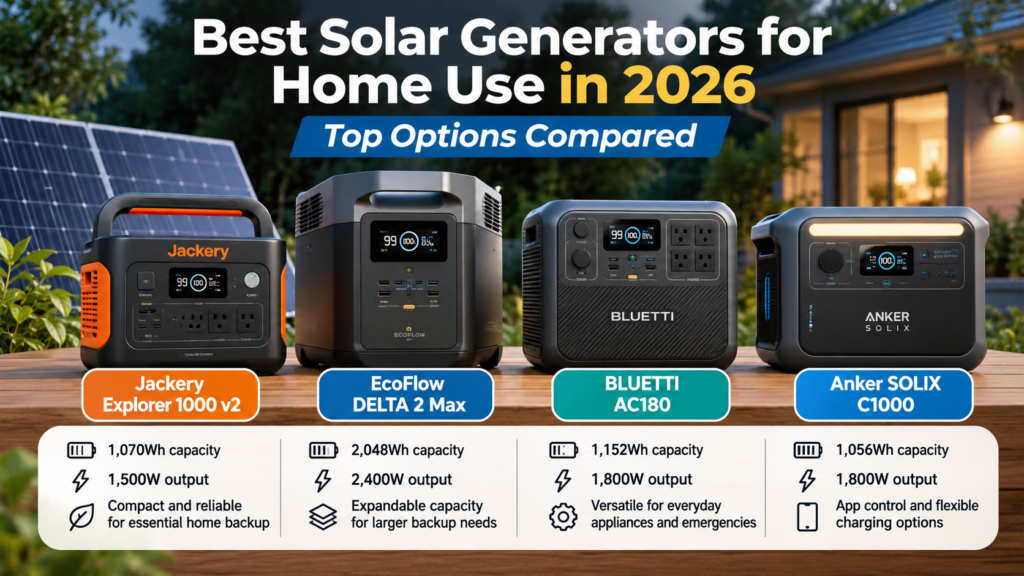
Best Solar Generators for Home Use in 2026: Quick Comparison
The best solar generator depends on the devices you want to operate, how long you need backup electricity, and whether you expect to recharge the battery using solar panels.
For this comparison, we’ve selected four portable power stations with different capacities and features. Each can support solar charging when paired with compatible equipment, although solar panels may be sold separately.
| Solar Generator | Battery Capacity | Rated AC Output | Maximum Solar Input | Best Suited For |
|---|---|---|---|---|
| Jackery Explorer 1000 v2 | 1,070Wh | 1,500W | Varies by supported charging configuration | Essential electronics and smaller backup loads |
| EcoFlow DELTA 2 Max | 2,048Wh | 2,400W | 1,000W | Larger backup loads and expandable capacity |
| BLUETTI AC180 | 1,152Wh | 1,800W | 500W | Everyday appliances and general emergency backup |
| Anker SOLIX C1000 | 1,056Wh | 1,800W | 600W | Compact home backup with flexible charging |
Specifications are based on manufacturer information. Regional versions, available outlets, charging accessories, and product configurations may differ. Check the exact model and local electrical specifications before purchasing.
These models are not interchangeable simply because they all support solar charging. A larger battery can provide longer runtime, but it may also increase weight and cost. Similarly, a higher AC output rating allows the system to support more demanding devices, but it does not necessarily mean the battery will last longer.
For homeowners, the most useful comparison is how well each system matches the equipment that needs electricity during an outage.
What Is a Solar Generator and How Does It Work?
A solar generator typically combines a rechargeable battery, power management electronics, and an inverter with the ability to receive electricity from compatible solar panels.
During normal conditions, the battery can be charged using a wall outlet. Many models also support vehicle charging and solar charging, giving users several ways to replenish stored energy.
When electricity is unavailable, the battery supplies power through its AC, USB, or DC outputs. This allows compatible devices to operate without requiring a conventional fuel-powered generator.
The Difference Between a Solar Generator and a Solar Panel
Solar panels convert sunlight into electrical energy. A portable power station stores that energy and makes it available to connected devices.
Although the two products are often marketed together, they serve different functions. A portable power station can operate without solar panels if its battery has already been charged, while solar panels can help replenish its battery during daylight hours.
The U.S. Department of Energy’s explanation of solar energy and storage describes how combining solar generation with battery storage makes electricity available beyond the hours when sunlight is being collected.
However, solar charging is affected by weather, panel positioning, shading, and the amount of sunlight available. A system advertised with a high solar charging input won’t necessarily receive that much power throughout the day.
Why Battery Capacity and Output Power Both Matter
Two of the most important specifications are battery capacity, measured in watt-hours (Wh), and output power, measured in watts (W).
Battery capacity indicates how much energy is stored. Output power determines how much electricity the generator can deliver at a particular moment.
For example, a 1,000Wh power station supporting a continuous 100W load would theoretically provide 10 hours of operation. Actual runtime would be shorter because of conversion losses and the station’s own electricity consumption.
A refrigerator introduces another consideration: its compressor may require a brief surge of electricity when starting. Even if its average power consumption is relatively low, the solar generator must be capable of handling the startup demand.
Understanding these specifications is essential before deciding whether a solar generator can support your household appliances.
Best Solar Generators for Home Use: Four Options Worth Comparing
Rather than selecting products based entirely on advertised battery capacity, it’s more useful to examine their practical advantages, limitations, and intended applications.
The following four models represent different approaches to portable home backup.
1. Jackery Explorer 1000 v2 — For Essential Household Electronics
The Jackery Explorer 1000 v2 is a relatively compact portable power station designed for users who need backup electricity without moving a particularly large battery system around the house.
It offers 1,070Wh of battery capacity and a rated AC output of 1,500W. This makes it suitable for a range of compatible electronics, including laptops, networking equipment, lighting, and certain household appliances within its electrical limits.
The model uses lithium iron phosphate (LiFePO4) battery chemistry and supports solar charging with compatible panels. Its manageable size can be useful for households that want to move backup electricity between rooms or use the same equipment for occasional outdoor activities.
For example, a household experiencing a short blackout might prioritize a Wi-Fi router, laptop, several LED lights, and phone charging. A system in this capacity range can provide a useful energy reserve without requiring a large stationary installation.
However, it may not be the most practical choice for homeowners who want to run multiple high-consumption appliances simultaneously or maintain substantial backup power throughout a prolonged outage.
Jackery also offers larger-capacity models for users whose needs extend beyond essential electronics. The Explorer 2000 v2, for example, provides approximately 2,042Wh of capacity and a higher rated output, illustrating how the same product category can serve different household requirements.
The important consideration is not simply choosing a larger model, but determining whether the additional capacity is necessary for your expected electrical load.
Looking for a reliable backup power solution? Explore Jackery’s portable power stations and solar generators to find an option that fits your household’s power needs and budget.
2. EcoFlow DELTA 2 Max — For Larger Backup Loads and Expandability
The EcoFlow DELTA 2 Max offers a larger battery capacity of 2,048Wh and a rated AC output of 2,400W. Compared with smaller portable power stations, this gives homeowners more stored energy and greater flexibility when operating several compatible devices.
One of its distinguishing features is expandable battery capacity. With supported expansion batteries, the system can provide additional stored energy for households that need longer runtime.
This can be useful when a home backup setup includes a refrigerator, networking equipment, lighting, and other essential loads. Rather than replacing the entire power station, compatible expansion batteries provide a way to increase capacity.
The DELTA 2 Max also supports up to 1,000W of solar input under specified conditions, although actual charging performance depends on the connected panels and available sunlight.
Its main disadvantage is portability. A larger battery system weighs more than a compact power station, and adding expansion batteries increases the amount of equipment that must be stored and maintained.
For homeowners who expect to use backup electricity regularly, however, the ability to expand capacity may be more valuable than having the smallest possible unit.
3. BLUETTI AC180 — For Everyday Appliances and General Emergency Backup
The BLUETTI AC180 offers 1,152Wh of battery capacity and a rated AC output of 1,800W. This places it in a useful middle category for homeowners who want more flexibility than a small power bank without moving to a much larger backup system.
It includes multiple output connections and supports several charging methods, including AC, solar, and vehicle charging.
The AC180’s 1,800W rated output allows it to support a range of compatible household devices, although startup requirements and combined electrical loads must still be considered.
For example, it may be suitable for keeping a laptop, router, lighting, and selected appliances operating during a temporary interruption. However, actual runtime will depend on how much electricity those devices consume.
The model supports up to 500W of solar input, which can be useful for replenishing energy during daylight hours when compatible panels and suitable weather conditions are available.
One limitation is that its battery capacity remains relatively modest for whole-home backup. Running multiple appliances continuously could drain the battery much faster than expected.
For homeowners who need a flexible emergency battery for selected devices rather than an entire household, the AC180 is worth considering.
4. Anker SOLIX C1000 — For Compact Backup With Flexible Charging
The Anker SOLIX C1000 combines a 1,056Wh battery with a rated AC output of 1,800W. Its capacity is similar to other portable power stations in the 1kWh category, making it suitable for smaller home backup setups.
It supports multiple output connections and up to 600W of compatible solar charging input. Anker also provides app-based monitoring and charging controls, which may appeal to users who want greater visibility into battery operation.
For a home office or household emergency kit, this type of system can provide backup electricity for networking equipment, computers, lighting, and other compatible devices.
Its relatively compact design also makes it useful for homeowners who want equipment that can be moved between rooms or stored when not needed.
However, a 1,056Wh battery still has practical runtime limits. If several high-power appliances are connected, stored energy can be consumed quickly despite the unit’s relatively high AC output rating.
For users considering this model, it is important to evaluate both the maximum output and the expected energy consumption of connected devices rather than relying on the wattage rating alone.
What These Solar Generators Have in Common
Despite differences in capacity and features, all four models share several characteristics that make them useful for selected home backup applications.
They store electricity in rechargeable batteries, provide AC power through built-in inverters, and support charging from compatible solar panels. They can also operate without producing the exhaust fumes associated with fuel-powered generators.
However, they are not complete replacements for permanent whole-home backup systems. Their batteries contain a finite amount of stored energy, and their ability to operate appliances depends on both continuous and startup power requirements.
They also require a safe charging and storage environment. Portable power stations should not be connected directly to household wiring through improvised cables or outlets. Any integration with a home’s electrical system requires appropriate equipment and qualified installation.
For most households, these products are best viewed as flexible backup electricity sources for selected essential devices rather than systems intended to power everything in the home.
How to Choose the Best Solar Generator for Your Home
Choosing the right solar generator involves more than comparing battery sizes or looking for the highest output rating. The best option depends on which appliances you want to power, how long you expect outages to last, and whether you plan to recharge the battery using solar panels.
A household that only needs electricity for phones, laptops, and a Wi-Fi router will have very different requirements from one that needs to keep a refrigerator operating during a prolonged blackout. Understanding these differences can help you avoid buying a system that is either too small or unnecessarily expensive.
Start With Your Essential Appliances
Before comparing solar generators, identify which devices you actually need during an outage. Focus on essential equipment rather than trying to power everything in your home.
For many households, the priority list includes a refrigerator, internet equipment, phones, laptops, LED lighting, and an electric fan. Some may also need backup electricity for medical equipment, although critical medical devices require a separately verified, reliable power plan rather than depending on an ordinary consumer power station alone.
If you work from home, keeping your computer and internet connection available may be especially important. A backup battery can help maintain electricity for your router and modem, but it cannot guarantee internet access if your service provider’s network also loses power.
When evaluating equipment for a home office, the same considerations used to choose backup power solutions for working from home apply: identify essential devices, measure their electrical consumption, and determine how long they need to remain operational.
Calculate Your Required Battery Capacity
Battery capacity is measured in watt-hours (Wh), which indicates how much energy a solar generator can store. To estimate the capacity you need, multiply the power consumption of your devices by the number of hours you want them to operate.
For example, consider the following essential household devices:
| Device | Estimated Power Consumption | Usage Duration | Energy Required |
|---|---|---|---|
| Wi-Fi router and modem | 20W | 8 hours | 160Wh |
| Laptop | 50W | 4 hours | 200Wh |
| LED lights | 20W | 6 hours | 120Wh |
| Electric fan | 45W | 5 hours | 225Wh |
| Total | 705Wh |
These are illustrative estimates. Actual consumption depends on the equipment and how it is used.
In this example, the devices require approximately 705Wh of electricity. However, solar generators lose some energy through power conversion and internal operation, so the advertised battery capacity should be higher than the calculated requirement.
Using an illustrative 85% usable-energy assumption:
705Wh ÷ 0.85 = approximately 829Wh
A solar generator with around 1,000Wh of capacity could therefore be worth considering for this particular setup. However, actual runtime will depend on the model’s efficiency, battery condition, and connected devices.
Check Continuous Output and Starting Power
Battery capacity determines how much energy is available, but output power determines which devices a solar generator can operate.
A power station with a 1,000Wh battery and a 1,500W inverter can support compatible loads within its output limits. However, operating a device that consumes 1,000W would drain its stored energy much faster than running a 100W device.
Some appliances, particularly those with motors or compressors, require additional power when starting. Refrigerators are a common example.
Before connecting an appliance, check its running wattage and startup requirements. The solar generator must support both the continuous load and any temporary surge.
This is especially important when multiple appliances are connected simultaneously.
How Long Can a Solar Generator Power Household Appliances?
One of the most common questions homeowners ask is how long a solar generator will last during a blackout.
The answer depends on three factors: battery capacity, electrical consumption, and the efficiency of the power station.
A simple estimate is:
Estimated runtime = Usable battery capacity ÷ Device power consumption
For example, a 1,000Wh solar generator with an assumed 85% usable capacity provides approximately 850Wh of energy to connected devices.
If the connected equipment consumes 100W continuously, the estimated runtime would be approximately 8.5 hours.
However, household appliances don’t always consume electricity at a constant rate. Refrigerators cycle on and off, laptops change power consumption depending on workload, and some devices use additional energy during startup.
Estimated Runtime Comparison
The following table illustrates how long different battery capacities might support selected continuous loads.
| Connected Load | 500Wh Battery | 1,000Wh Battery | 2,000Wh Battery |
|---|---|---|---|
| 20W — Router and modem | 21.3 hours | 42.5 hours | 85 hours |
| 60W — Laptop and small accessories | 7.1 hours | 14.2 hours | 28.3 hours |
| 100W — Small home office setup | 4.3 hours | 8.5 hours | 17 hours |
| 150W — Multiple essential devices | 2.8 hours | 5.7 hours | 11.3 hours |
| 300W — Higher household load | 1.4 hours | 2.8 hours | 5.7 hours |
Estimates assume 85% usable battery capacity and constant electrical consumption. Actual runtime may differ significantly, particularly at very low loads or when using appliances that cycle on and off.
This comparison shows why battery capacity should be matched to your actual needs. A smaller solar generator may provide many hours of electricity for networking equipment but only a short period for more demanding appliances.
Can a Solar Generator Run a Refrigerator?
Yes, many solar generators can operate compatible refrigerators, provided the power station has sufficient continuous output and startup surge capability.
However, refrigerator energy consumption varies considerably depending on size, age, temperature settings, insulation, and how frequently the door is opened.
A refrigerator may consume several hundred watts while its compressor is operating but much less electricity over time because the compressor cycles on and off.
For a more reliable runtime estimate, check the refrigerator’s energy label or measure its electricity consumption over a representative period. You should also verify its startup requirements before choosing a solar generator.
During a blackout, keeping refrigerator doors closed can help preserve internal temperatures and reduce unnecessary cooling demand.
The U.S. Food and Drug Administration’s food safety guidance explains that an unopened refrigerator generally keeps food cold for approximately four hours during a power outage, while a full freezer can maintain its temperature for approximately 48 hours if it remains closed.
A solar generator may help extend refrigeration time, but food safety should still be assessed using appropriate temperature measurements rather than assuming that intermittent power automatically keeps food safe.
Solar Charging: How Many Solar Panels Do You Need?
Solar charging is one of the main reasons homeowners consider solar generators instead of ordinary battery backups.
With compatible solar panels, a portable power station can collect electricity during daylight hours and store it for later use. This can be especially useful during extended outages when access to wall charging is limited.
However, the amount of electricity a solar panel produces depends on sunlight, weather, panel orientation, shading, and the charging capabilities of the power station.
Understanding Solar Panel Wattage
Solar panels are commonly advertised according to their rated output under standardized test conditions.
A 200W solar panel does not necessarily produce 200W throughout the day. Actual output can be considerably lower depending on environmental conditions.
For example, if a 200W panel produces an average of 140W over four hours of useful sunlight, it would generate approximately:
140W × 4 hours = 560Wh
The amount ultimately stored in the battery would be lower after charging losses.
This illustrates why solar charging estimates should be based on realistic sunlight conditions rather than multiplying the panel’s advertised wattage by every daylight hour.
How Long Does Solar Charging Take?
Suppose a portable power station has a 1,000Wh battery and receives an average of 200W of usable charging power.
Under simplified conditions, replenishing 1,000Wh would require approximately five hours:
1,000Wh ÷ 200W = 5 hours
In reality, charging may take longer because sunlight changes throughout the day, charging efficiency is imperfect, and charging power can decrease as the battery approaches full capacity.
The U.S. Department of Energy’s solar photovoltaic guidance explains how photovoltaic cells convert sunlight into electricity and why solar performance depends on operating conditions.
For homeowners, the important question is not simply how quickly a battery can charge under ideal conditions, but whether the available solar panels can replenish enough energy to support daily electricity needs during an extended outage.
Solar Panels Are Not Always Included
Some portable power stations are sold individually, while others are offered in bundles with compatible solar panels.
Before purchasing, check whether the advertised price includes the panels, charging cables, adapters, and other accessories you need.
Also verify the power station’s supported solar input voltage and current. Not every solar panel is compatible with every portable power station, even when the connector appears similar.
Solar Generators vs Traditional Home Backup Systems
Solar generators are useful for portable, temporary electricity, but they are not necessarily the best solution for every household.
A portable solar generator may be sufficient for keeping essential electronics operating during occasional outages. However, homeowners who want to support large appliances, air-conditioning systems, or entire electrical circuits may need a more substantial backup installation.
| Feature | Portable Solar Generator | Whole-Home Battery System | Gas Generator |
|---|---|---|---|
| Typical purpose | Selected appliances and electronics | Household circuits or larger loads | Selected appliances or household backup |
| Portability | Usually portable | Permanently installed | Portable or permanently installed |
| Fuel required | No combustible fuel | No combustible fuel | Gasoline, diesel, natural gas, or propane |
| Solar compatibility | Model-dependent | System-dependent | Generally not applicable |
| Installation | Often plug-and-play for individual devices | Professional installation | Depends on connection and system type |
| Main limitation | Limited stored energy and output | Higher installation cost | Exhaust, noise, and fuel requirements |
Portable solar generators can be particularly convenient for renters or homeowners who don’t want a permanent installation. They can also serve multiple purposes, including emergency backup, outdoor activities, and temporary workspaces.
However, they should not be connected directly to household wiring through improvised cables or outlets. Powering home circuits requires properly designed equipment and qualified electrical installation.
Fuel-powered generators introduce additional safety considerations. According to the CDC’s generator safety guidance, portable fuel-powered generators must be operated outdoors and kept well away from windows, doors, and vents because their exhaust contains dangerous carbon monoxide.
Battery-based solar generators avoid combustion exhaust during operation, but they still require proper charging, ventilation, storage, and electrical handling.
Common Mistakes to Avoid When Buying a Solar Generator
One of the biggest mistakes is choosing a solar generator based entirely on battery capacity. A large battery may offer longer runtime, but it won’t necessarily support appliances that exceed its output rating.
Another common mistake is assuming that solar panels will fully recharge the battery every day. Solar charging depends on available sunlight and panel capacity, and poor weather can significantly reduce energy production.
Some buyers also underestimate how much electricity household appliances consume. A laptop and router may require relatively little power, while electric kettles, heaters, and other high-wattage devices can drain a portable battery very quickly.
It’s also important not to confuse a portable solar generator with a dedicated UPS. Some models provide automatic power transfer, but their transfer times and operating modes vary. If you’re protecting a desktop computer or other sensitive equipment, verify the manufacturer’s specifications.
Finally, consider how often you’ll use the equipment. A larger and more expensive system may be worthwhile for frequent outages, but it may offer little practical benefit if you only need occasional backup charging for a few small devices.
Frequently Asked Questions
What is the best solar generator for home use in 2026?
The best solar generator depends on your electrical requirements. Around 1,000Wh may be suitable for essential electronics and smaller backup loads, while systems with 2,000Wh or more can provide additional runtime for larger setups. Output power, solar charging compatibility, and appliance startup requirements are equally important.
Can a solar generator power an entire house?
Most portable solar generators are intended for selected appliances rather than an entire home. Larger expandable systems may support more substantial loads, but powering household circuits safely requires compatible equipment and appropriate installation.
Do solar generators work at night?
Yes. A solar generator operates using electricity stored in its battery, so it can power compatible devices at night or when sunlight is unavailable. However, solar panels cannot replenish the battery without sufficient sunlight.
How long does a 1,000Wh solar generator last?
Runtime depends on connected power consumption and efficiency. Using an illustrative 85% usable-energy assumption, a 1,000Wh battery could support a continuous 100W load for approximately 8.5 hours. Actual results vary by model and operating conditions.
Can I use a solar generator without solar panels?
Yes. Most portable solar generators can be charged from a wall outlet, and many support additional charging methods. Solar panels are optional for models that support multiple charging sources, although they can be useful during extended outages.
Is a solar generator better than a gas generator?
A solar generator is quieter, produces no combustion exhaust during operation, and requires no fuel purchases. However, it has limited stored energy and depends on available charging sources. A gas generator can provide electricity for longer periods when sufficient fuel is available, but it requires outdoor operation, maintenance, and safe fuel handling.
Are solar generators worth buying for occasional power outages?
They can be worthwhile if you need a convenient source of backup electricity for essential devices. However, the value depends on outage frequency, battery capacity, supported equipment, and cost. For very brief interruptions, a smaller UPS or power bank may be sufficient.
Final Thoughts
The best solar generators for home use in 2026 offer a practical way to keep essential electronics and selected household appliances operating during electricity interruptions. However, choosing the right system requires understanding more than battery capacity alone.
Compact models around 1,000Wh can be useful for laptops, networking equipment, lighting, and smaller backup loads. Larger systems offer additional stored energy and may be more suitable for households that need longer runtime or want to operate several devices.
Jackery, EcoFlow, BLUETTI, and Anker SOLIX each offer options worth considering, but the right choice depends on your electrical load, expected outage duration, solar charging requirements, and budget.
Before purchasing, identify your essential devices, calculate their energy consumption, check continuous and startup power requirements, and confirm compatibility with your local electrical system.
A well-matched solar generator won’t necessarily power everything in your home, but it can make an unexpected blackout considerably easier to manage.
Did this solve your problem?
Your answer helps Supportia prioritize updates. No account or email is required.
Related guides
Solar Generator vs Gas Generator: Which Is Better for Home Backup in 2026?
A solar generator is better for quiet, indoor backup power, making it ideal for laptops, Wi-Fi routers, lighting, and selected household appliances. A gas…
Historical guide — verify current detailsTop Media Streaming Apps for Mac Compared: ArkMS and other popular options
Discover the best media streaming apps for Mac in 2026, including ArkMS, Plex, Kodi, and VLC. Compare features, performance, and use cases to find…
Historical guide — verify current detailsBest Backup Power Solutions for Working From Home in 2026
A UPS is best for preventing sudden PC shutdowns, a power bank suits laptops, and a portable power station supports multiple devices during longer…
Historical guide — verify current details