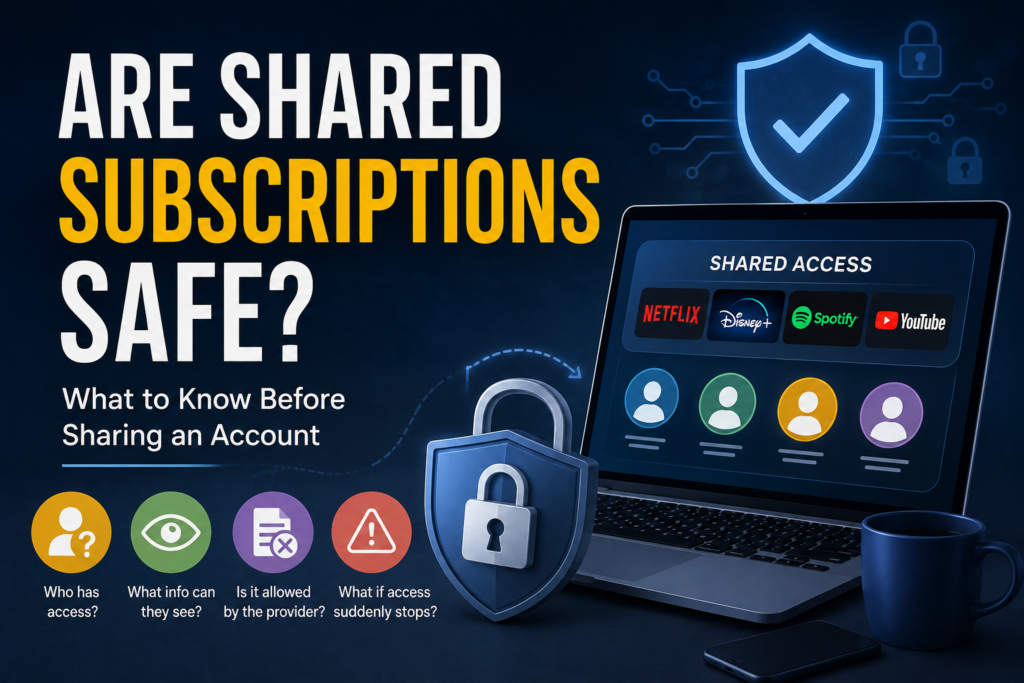
Are shared subscriptions safe? They can be, but the answer depends on how the subscription is shared, who controls the account, and what information other users can access.
Sharing Netflix with someone in your household is very different from buying access to an account owned by someone you’ve never met. Some services let each person keep their own login, while others give several people access to profiles under the same account.
Those differences matter. They can affect your privacy, account security, viewing history, and even whether you’ll still have access next month.
Before joining any shared subscription, it’s worth understanding exactly what you’re paying for and what you’re potentially giving up in exchange for a lower price.
What Is a Shared Subscription?
A shared subscription is simply a paid service being used by more than one person.
The most familiar example is a family plan. One person pays for the subscription while other members receive their own profiles or accounts.
But not every shared subscription works that way.
You might receive a separate profile within someone else’s account. You might be invited to a family group using your own email address. In other cases, several people may receive the same username and password.
These arrangements can feel almost identical when you’re simply watching a movie or listening to music, but they’re quite different when it comes to security and control.
Netflix, for example, defines a Netflix Household around devices connected to the internet at the primary place where the account is used. People outside the household generally need their own account or an eligible extra-member arrangement.
So the fact that a subscription supports multiple profiles doesn’t necessarily mean those profiles can be shared freely with anyone.
Are Shared Subscriptions Safe?
Shared subscriptions are generally safer when you keep control of your own account and password.
For example, being invited to an eligible family plan using your own account is different from receiving the username and password for an account that several strangers also use.
The second arrangement introduces more uncertainty.
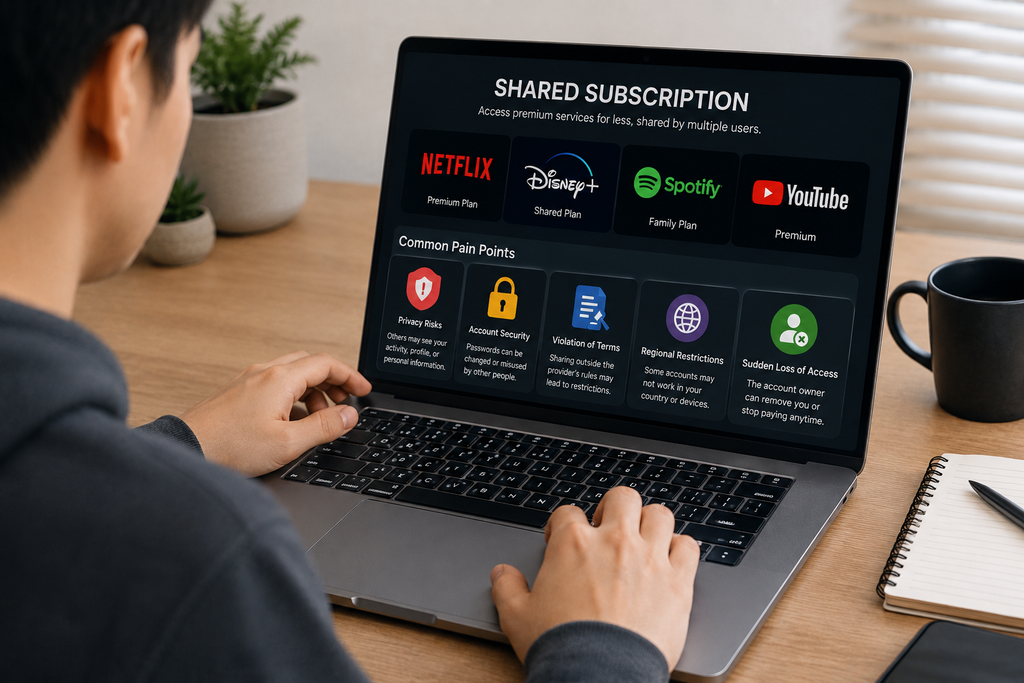
Other users might be able to see profiles, activity or account information. Someone with sufficient access could potentially change settings or interfere with other profiles. And if you aren’t the account owner, you may have limited options if the password suddenly changes.
There’s also the question of account recovery. If something goes wrong with an account you don’t own, you usually won’t have the same recovery options as the person whose email address or phone number is attached to it.
None of this means every shared subscription is automatically unsafe. It means the way the account is shared matters just as much as the price.
Shared Profile vs Shared Account: Know the Difference
A shared profile and a shared account aren’t quite the same thing.
With a shared profile arrangement, several people may use one main subscription while maintaining separate profiles for recommendations, history and preferences.
Netflix, for example, supports separate profiles within an account. Each profile can have its own viewing activity, recommendations, My List, playback settings and other preferences.
A shared account, on the other hand, may mean several people know the same login credentials.
That’s potentially more sensitive because access isn’t necessarily limited to one profile.
There’s also another arrangement where you continue using your own account but someone else provides access to the paid plan. Family-plan invitations and some subscription-sharing arrangements can work this way.
Before paying, find out exactly which arrangement you’re getting.
If you can use your own account and keep your own password, that’s usually preferable to receiving credentials for an account controlled by someone else.
Are Shared Subscriptions Safe With People You Don’t Know?
This is where you need to be more cautious.
Sharing an account with a family member is one thing. Sharing one with several strangers introduces risks that aren’t present when everyone knows and trusts each other.
The other users may change. You may not know who has the password, how many people have received it, or whether someone has saved the credentials somewhere insecurely.
Privacy is another consideration.
Even if other users can’t see sensitive payment information, they may still be able to see profile names, viewing or listening activity, recommendations, playlists, recently watched content or other account information depending on the service.
If you’re joining a shared subscription with people you don’t know, avoid attaching information to the account that you wouldn’t want other users to see.
Most importantly, never reuse the shared account’s password anywhere else.
A password used for Netflix, Spotify or another shared service should never also be the password for your email, banking, social media or other important accounts.
Check the Provider’s Sharing Rules First
Paying for access doesn’t automatically mean the original subscription provider allows that particular sharing arrangement.
Every provider sets its own rules.
Netflix is a useful example. Although an account can contain multiple profiles, its account-sharing rules are based around a Netflix Household, with separate provisions for eligible extra members outside that household.
Other services may have requirements involving family groups, countries, household addresses, devices or how frequently an account must verify its location.
These rules can also change.
That’s important when you’re considering paying several months in advance. An arrangement that works today could encounter additional verification or restrictions if the provider changes how it enforces account sharing.
Before paying, check the original provider’s current rules rather than relying only on what the person or company selling access tells you.
Are Shared Subscriptions Safe Through Subscription-Sharing Services?
Subscription-sharing services add another layer to the decision because you’re no longer dealing only with the original subscription provider.
Platforms such as GamsGo offer access to various digital subscriptions at lower prices. Depending on the product, the way access is provided can differ, so it’s important to check the details of the individual subscription rather than assuming every service works the same way.
Look at whether you’re receiving your own account, joining an existing plan, using a separate profile, or being given credentials to a shared account.
You should also check the subscription duration, region requirements, device restrictions, what happens if access stops, and what support or replacement policy applies.
The lower price can certainly be attractive, but it shouldn’t be the only thing you consider.
Understanding how the access actually works is much more useful than simply comparing the monthly price.
What Information Can Other People See on a Shared Account?
One thing that’s easy to overlook with shared subscriptions is privacy. Even when everyone has a separate profile, that doesn’t necessarily mean everything you do on the account is completely private.
Exactly what other users can see depends on the service and how the account is configured. On a streaming platform, this might include profile names, recently watched content, recommendations, playlists, or other activity. Someone with control of the main account may also have access to settings that ordinary profile users don’t.
Payment details are generally better protected, but you still shouldn’t assume that information stored inside a shared account is visible only to you. If you’re using an account that belongs to someone else, it’s sensible to keep unnecessary personal information off it and avoid treating it like one of your private accounts.
This is one reason official family plans or arrangements that let everyone maintain their own account can be preferable to several people sharing the same username and password.
What Happens If the Shared Subscription Stops Working?
When you subscribe directly to a service, you’re normally the account owner. If you forget the password, encounter a billing problem, or get locked out, you can usually contact the provider and try to recover access.
Shared subscriptions can work differently because the person using the service isn’t always the person who owns the main account. The account owner could change the password, remove a profile, reorganize a family group, or simply stop paying for the subscription. The provider could also request additional verification or change how it enforces its sharing rules.
Before paying for a shared subscription, find out what happens in these situations. If you’re using a service such as GamsGo, check the details for the particular subscription you’re considering because the method used to provide access can vary between products.
The importance of this depends partly on what you’re buying. Losing access to an entertainment service for a day is annoying. Losing access to an account containing important files or personal information can be a much bigger problem.
How to Protect Yourself When Using a Shared Subscription
You don’t need an elaborate security setup to use a shared subscription more safely. The most important rule is to keep the shared account separate from accounts that actually matter.
Use a password that you don’t use for email, banking, social media, shopping, or other personal services. If the subscription lets you join using your own account, that’s generally preferable to receiving credentials that several other people also know.
Be careful about the information you add as well. There’s rarely a good reason to store sensitive personal information on an account you don’t control, and you should avoid saving payment details unless they’re genuinely needed.
Two-factor authentication is also worth enabling on personal accounts you control. It won’t solve every risk associated with a shared subscription, but it can help prevent a compromised password from becoming a much larger problem.
The basic idea is simple: treat a shared account as shared space, not as your private account.
Are Shared Subscriptions Safe for Important Software and Cloud Services?
Are shared subscriptions safe when the service contains your files, email, passwords, backups, or work? This is where the risks become much more significant.
There’s a major difference between sharing an entertainment subscription and sharing an account that contains information you can’t easily replace. Cloud storage, for example, might hold family photos, financial documents, scanned IDs, work files, or years of personal records.
For services like these, maintaining control of the main account is usually far more important than getting the lowest possible monthly price. The same applies to password managers, email accounts, backup services, and business applications containing confidential information.
If you’re trying to reduce storage costs, comparing legitimate free and paid plans is generally safer than giving someone else control over the account holding your files. Supportia’s comparison of cloud storage services covers several options for keeping files online while maintaining your own account.
Shared access makes more sense when losing that access would be an inconvenience rather than a serious problem.
When a Shared Subscription May Be Worth Considering
Shared subscriptions aren’t automatically a bad idea. In the right situation, they can provide access to services you already use while reducing the amount each person pays.
Official family plans are probably the easiest example. The provider has deliberately designed the subscription for several users, and each person may receive their own profile or account while one person handles the billing.
Third-party subscription-sharing services require a little more consideration because the arrangement varies depending on the product. Before deciding based on the advertised monthly price, check who controls the account, whether you receive your own profile or login, whether regional restrictions apply, and what happens if access stops.
For entertainment and other non-critical services, you might decide those limitations are acceptable in exchange for the savings. For an account containing important personal or work information, having full control is usually more valuable.
Questions to Ask Before Paying for a Shared Subscription
You don’t need to investigate every subscription like a security professional. You just need to understand what you’re buying.
Start with the most important question: Will you have your own account, or will you be using someone else’s? From there, find out whether other users will know the same password, whether they can see your activity, and whether the original provider allows that type of sharing.
It’s also worth checking for household or regional restrictions and finding out what happens if access suddenly stops. If you can’t recover the account yourself, there should at least be a clear process for getting support or replacement access.
If a seller can’t clearly explain how the subscription works before you pay, that’s useful information in itself. A very cheap subscription isn’t much of a bargain if you’re constantly dealing with password changes, verification requests, or interrupted access.
Final Thoughts: Are Shared Subscriptions Safe?
So, are shared subscriptions safe? They can be, particularly when you’re using an official family plan or another arrangement that lets you keep control of your own account. The risks increase when several strangers share credentials or when you don’t know who ultimately controls the subscription.
Services such as GamsGo can make some digital subscriptions more affordable, but price shouldn’t be the only consideration. Understanding the type of access you’re receiving, the original provider’s sharing rules, and what happens if that access disappears will help you make a much better decision.
For entertainment and other relatively low-risk services, a shared subscription may be a reasonable trade-off. For email, cloud storage, passwords, backups, and accounts containing important personal information, keeping full control of your own account is usually worth more than the potential savings.
Did this solve your problem?
Your answer helps Supportia prioritize updates. No account or email is required.
Related guides
Firmware Updates vs. Device Performance: What to Know
Firmware updates can improve your device’s speed, security, and compatibility - but they’re not without risks. While updates often fix bugs, optimize performance, and…
Historical guide — verify current detailsForgotten Password: A Safe Account-Recovery Guide
Account recovery should begin from a provider’s official app or a manually entered address, not from a link supplied by a stranger or unexpected…
Reviewed 2026-08-23How to Protect Your Windows PC From Ransomware: 8 Practical Steps
Knowing how to protect your Windows PC from ransomware matters because ransomware doesn't just make a computer annoying to use. A successful attack can…
Historical guide — verify current details